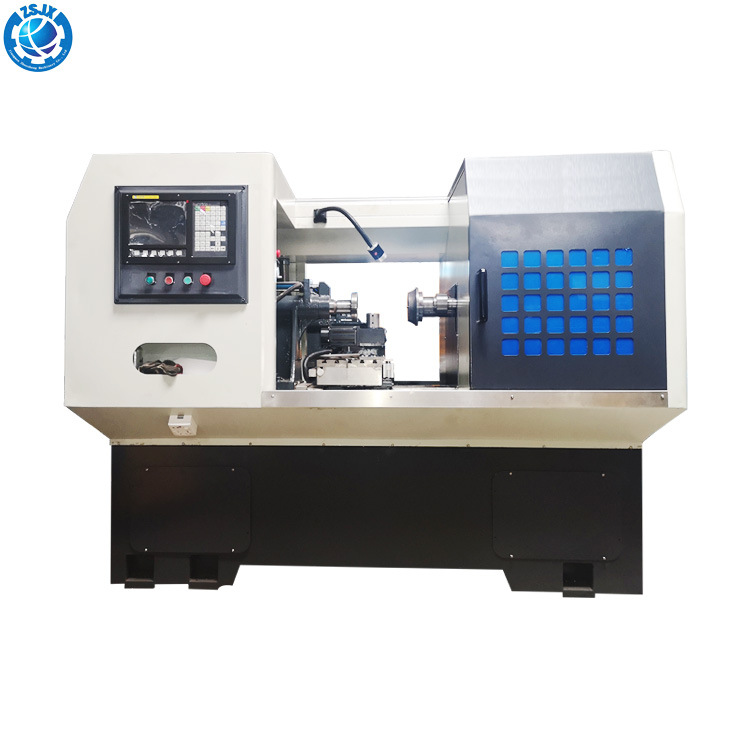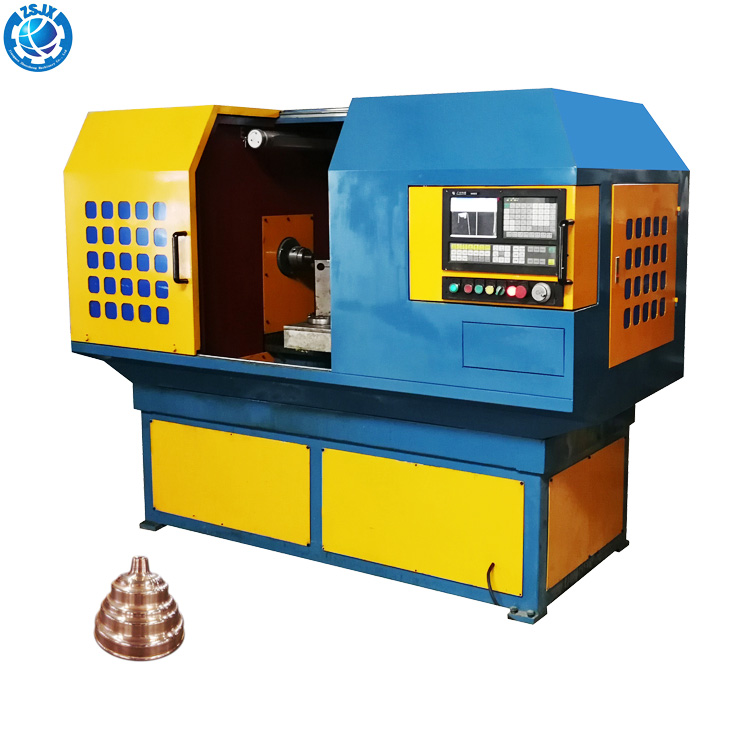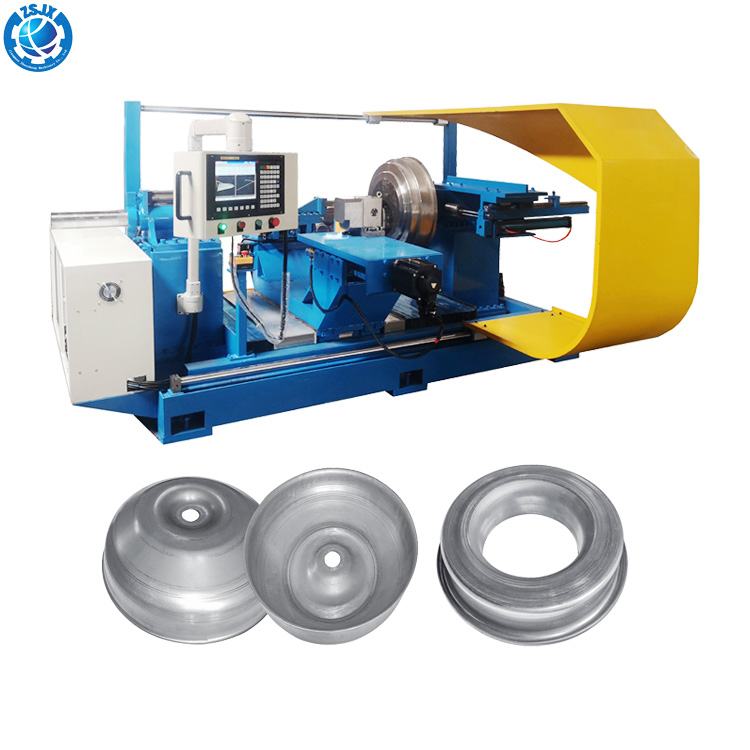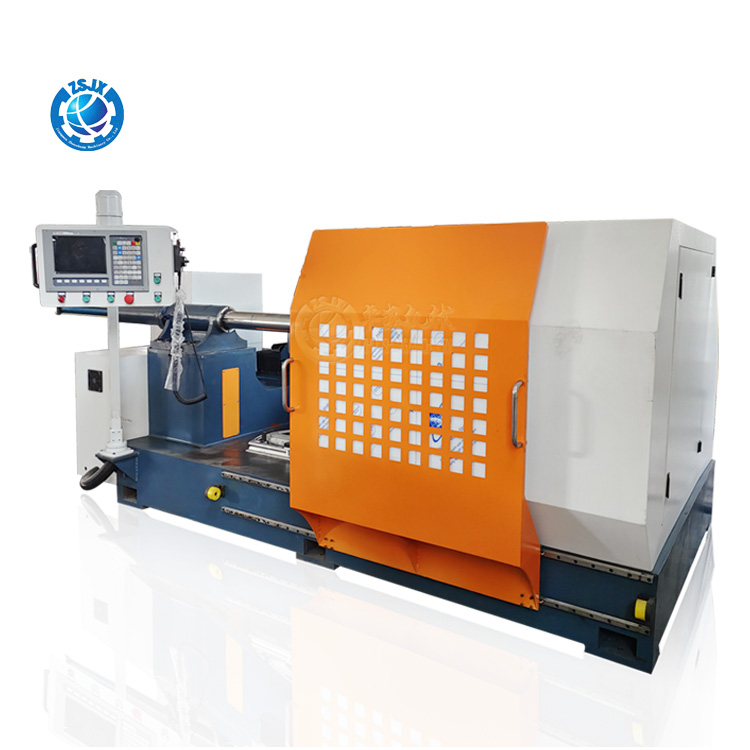
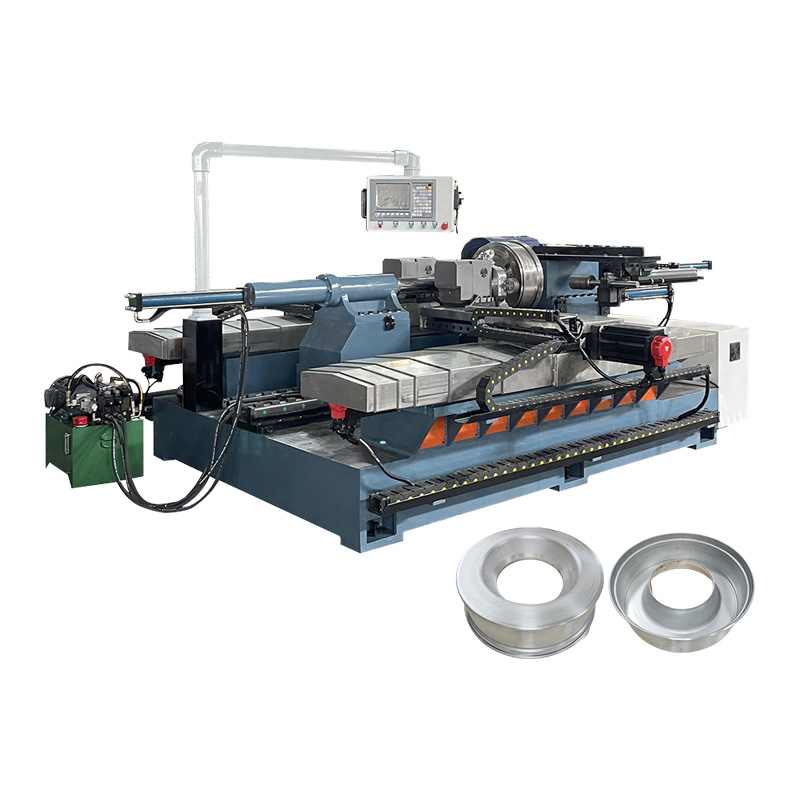
Single Wheel Metal Spinning Lathe is a single wheel CNC machine designed for metal spinning process. The metal blank is rotated by the spindle, and the single wheel tool applies pressure to make it plastically deformed, finally forming an axisymmetric hollow rotating body part. This equipment is widely used in aerospace, automobile manufacturing, energy and medical equipment and other fields, and is the core equipment for precision metal forming processing.
Single Wheel High Precision Control
Single Wheel Pressure Adjustment: The servo motor is used to drive the spinning wheel, and the pressure control accuracy reaches ±0.1mm, which can meet the forming requirements of different materials (such as aluminum alloy and stainless steel).
Dynamic Compensation Technology: The built-in sensor monitors the material deformation during the spinning process in real time, automatically adjusts the tool trajectory, and reduces the rebound error.
High-efficiency Spindle System
High-speed Spindle: The spindle speed range is 50-4500rpm, which supports the processing of high-strength materials such as cemented carbide and titanium alloy.
Low Vibration Design: The spindle box adopts resin sand casting technology, combined with a dual hydraulic balancing system, which reduces the vibration amplitude by 40% and extends the tool life.
Modular tool system
Quick-change spinning wheel: supports quick replacement of various spinning wheels such as conical, spherical, cylindrical, etc., with switching time ≤5 minutes.
Customized tools: can provide spinning wheels with special treatments such as laser engraving and surface hardening to meet the processing needs of complex parts.
Intelligent control system
CAD/CAM integration: compatible with mainstream software such as SolidWorks and Mastercam, and supports direct import of 3D models for programming.
Remote monitoring function: through industrial Ethernet connection, you can view equipment status, production data and fault warning in real time.
Energy-saving and environmentally friendly design
Low-energy hydraulic station: variable pump technology is used to reduce energy consumption by 30%, and noise is ≤70dB.
Circulating cooling system: built-in coolant filtration device to extend the service life of cutting fluid and reduce waste liquid discharge.
Aerospace field
Application scenario: manufacturing key components such as aircraft engine turbine discs, rocket fuel tanks, satellite brackets, etc.
Solving pain points: single-wheel spinning technology can achieve one-time forming of complex surfaces, reduce welding processes, and improve structural strength.
Automobile manufacturing industry
Application scenarios: production of lightweight parts such as aluminum alloy wheels, brake calipers, and drive shafts.
Pain point solution: Compared with traditional forging processes, single-wheel spinning lathes can reduce material loss by 20% and shorten processing cycles by 40%.
Energy equipment manufacturing
Application scenarios: manufacturing wind turbine tower flanges, nuclear power pressure vessel heads, natural gas storage tanks, etc.
Pain point solution: Spin forming can achieve uniform thinning of thick-walled parts, improve material utilization, and reduce manufacturing costs.
Medical device field
Application scenarios: production of orthopedic implants (such as artificial acetabulum), surgical instrument handles, dental implants, etc.
Pain point solution: single-wheel spinning technology can achieve high-precision surface finish (Ra≤0.8μm), meeting medical-grade cleanliness requirements.
Lighting and home appliance industry
Application scenarios: manufacturing LED reflective cups, aluminum lampshades, refrigerator evaporators, etc.
Pain point solution: Spin forming can achieve high-precision forming of thin-walled parts, improving product heat dissipation performance and aesthetics.
Rail transit equipment
Application scenarios: production of subway vehicle wheelsets, high-speed rail brake discs, rail vehicle couplers, etc.
Pain point solution: single-wheel spinning lathes can process large diameter (diameter ≤ 2000mm) parts to meet the stringent standards of rail transit equipment.
Petrochemical industry
Application scenarios: manufacturing pressure vessel heads, heat exchanger tube sheets, pipe joints, etc.
Pain point solution: Spinning can achieve uniform thinning of thick-walled parts, reduce welding stress, and improve equipment safety.
Daily maintenance
Lubrication system: check the hydraulic oil level and oil quality daily, and replace the hydraulic oil every 3 months.
Electrical system: clean the electrical cabinet every month and check whether the terminal is loose to avoid short circuit risks.
Regular maintenance
Spindle accuracy calibration: check the spindle runout every 6 months. If it exceeds 0.02mm, professional adjustment is required.
Spinning wheel wear detection: after processing 1,000 parts, measure the spinning wheel diameter. If the wear exceeds 0.5mm, it needs to be replaced.
Troubleshooting
Abnormal vibration: Check the spindle bearing, tool balance and foundation stability, and perform dynamic balancing correction if necessary.
Insufficient pressure: Check the hydraulic pump, solenoid valve and oil circuit blockage, and clean or replace the faulty parts.
Q: Can a single-wheel spinning lathe process stainless steel materials?
A: It can process stainless steels such as 304 and 316L. It is necessary to use a high-hardness spinning wheel (such as HRC60 or above) and adjust the process parameters.
Q: How much floor space does the equipment occupy?
A: The standard model (such as DS-5L) occupies an area of about 3.5m² and a height of 2.2m, which is suitable for small and medium-sized workshops.
Q: Does it support automatic loading and unloading?
A: An optional robot integration system can be used to realize automatic clamping of blanks and removal of finished products to improve production efficiency.
Q: How to ensure processing accuracy?
A: A closed-loop control system is adopted, and the repeated positioning accuracy reaches ±0.003mm, meeting ISO 9001 quality standards.
Q: Does it support customized development?
A: The spindle power, spinning force, stroke and other parameters can be customized according to customer needs.
Q: What are the advantages compared with traditional spinning machines?
A: The single-wheel design reduces tool interference and improves forming accuracy; the CNC system realizes complex surface processing and shortens the R&D cycle.
1. Non-standard customization: meet personalized technical requirements.
2. Samples and drawings: professional R&D team design.
3. Flexible payment: T/T, LC, international bank.
4. Video factory inspection: can be scheduled.
5.Experienced professional sales service team.
6. Visual production process.
1. Provide circuit diagrams, maintenance manuals,full-course teaching videos and other materials required.
2. Full-time after-sales service, cooperate with customers to inspect, install and test.
3. Quick response: respond within 24 hours if there are any problems with the customers use.